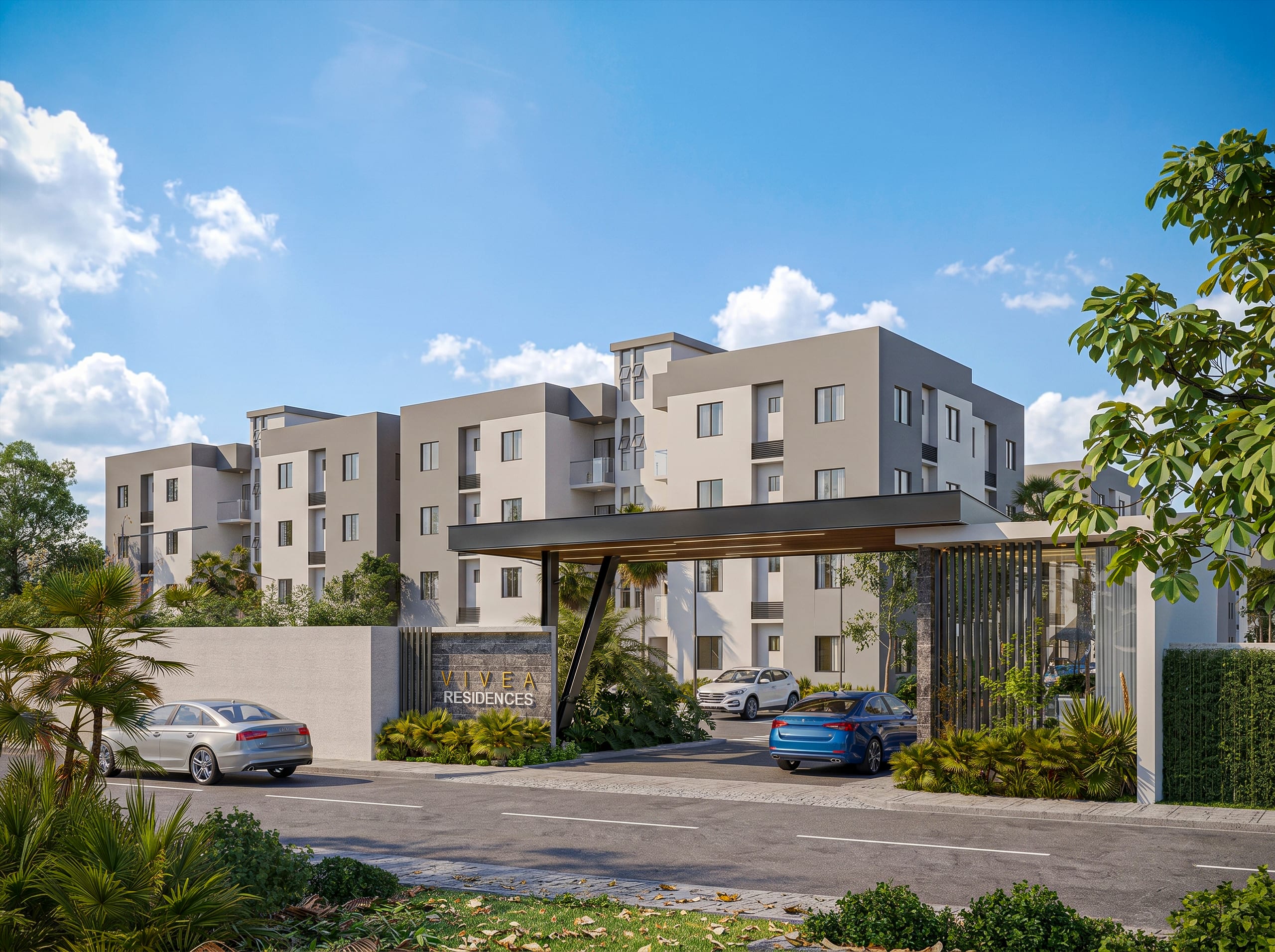
Vivea Residences, a low-cost housing project with the DGII housing bonus, sold by Murcia Group. Ask about available units.
If you're about to buy your first home in a low-cost housing project in the Dominican Republic, there's a benefit worth knowing about before you sign: the Low-Cost Housing Bonus (Bono de Vivienda de Bajo Costo) managed by the Dominican tax authority, the DGII. Here's a plain-language guide to what it is, who qualifies, what paperwork is needed and how to check whether a project is part of the program.
What is the housing bonus?
According to the DGII's Taxpayer Guide No. 26, the bonus is a refund of the ITBIS (the Dominican VAT) paid while building low-cost housing projects developed through a trust (fideicomiso).
You don't receive it as cash. Instead, it's applied to your purchase in one of two ways:
- To complete your down payment.
- To pay down the principal of your mortgage, if your down payment is already covered.
The DGII doesn't publish a fixed bonus amount: it depends on the ITBIS paid during construction of each project. The project's trust company (fiduciaria) can tell you how much applies to your unit.
The legal basis in brief
The benefit comes from Article 129 of Law 189-11 on the Mortgage Market and Trusts, as amended by Law 338-21. The price cap is adjusted for inflation every year (Article 327 of the Tax Code), and the application procedure is set out in General Rule 01-2015, as amended by General Rule 02-2016. The DGII summarizes all of this in its Guide No. 26, updated in January 2026.
Who qualifies?
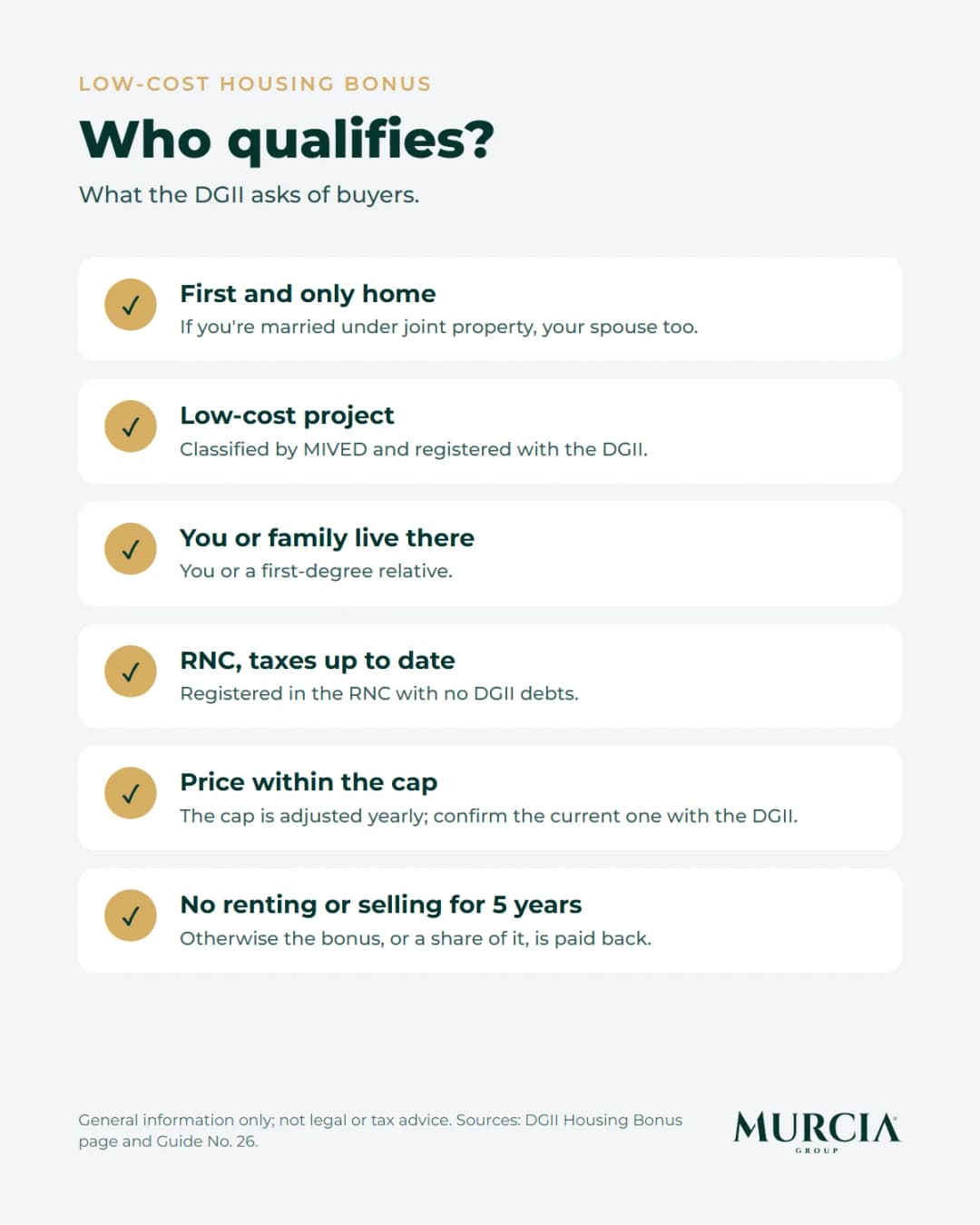
Per the DGII, you must meet these conditions:
- It must be your first and only home. If you're married under joint property, your spouse must meet this requirement too.
- The project must be classified as "low-cost housing" by the Ministry of Housing (MIVED) and registered with the DGII.
- The unit and the project must be clearly identified.
- You must live in the home, or a first-degree relative must.
- You must be registered in the taxpayer registry (RNC) and up to date with your taxes.
One more thing: Guide No. 26 states that the home can't be rented out or transferred for at least 5 years. If it is, the buyer must pay back the full bonus or the share for the remaining years.
The price cap
A low-cost home is one whose sale price is at or below a legal cap, and that cap is adjusted each year for inflation.
For 2026, the DGII set the cap at RD$5,450,851.12 in Resolution DDG-AR1-2026-00001, dated January 15, 2026, and its Guide No. 26 confirms it for contracts signed after that resolution. Note that on the DGII's Housing Bonus web page, the amount written out in words still matches the previous cap (RD$5,193,655.47, from 2025); the current 2026 figure is the one in the guide.
Because the cap changes every year, always confirm the current value with the DGII or your trust company before signing.
Step by step
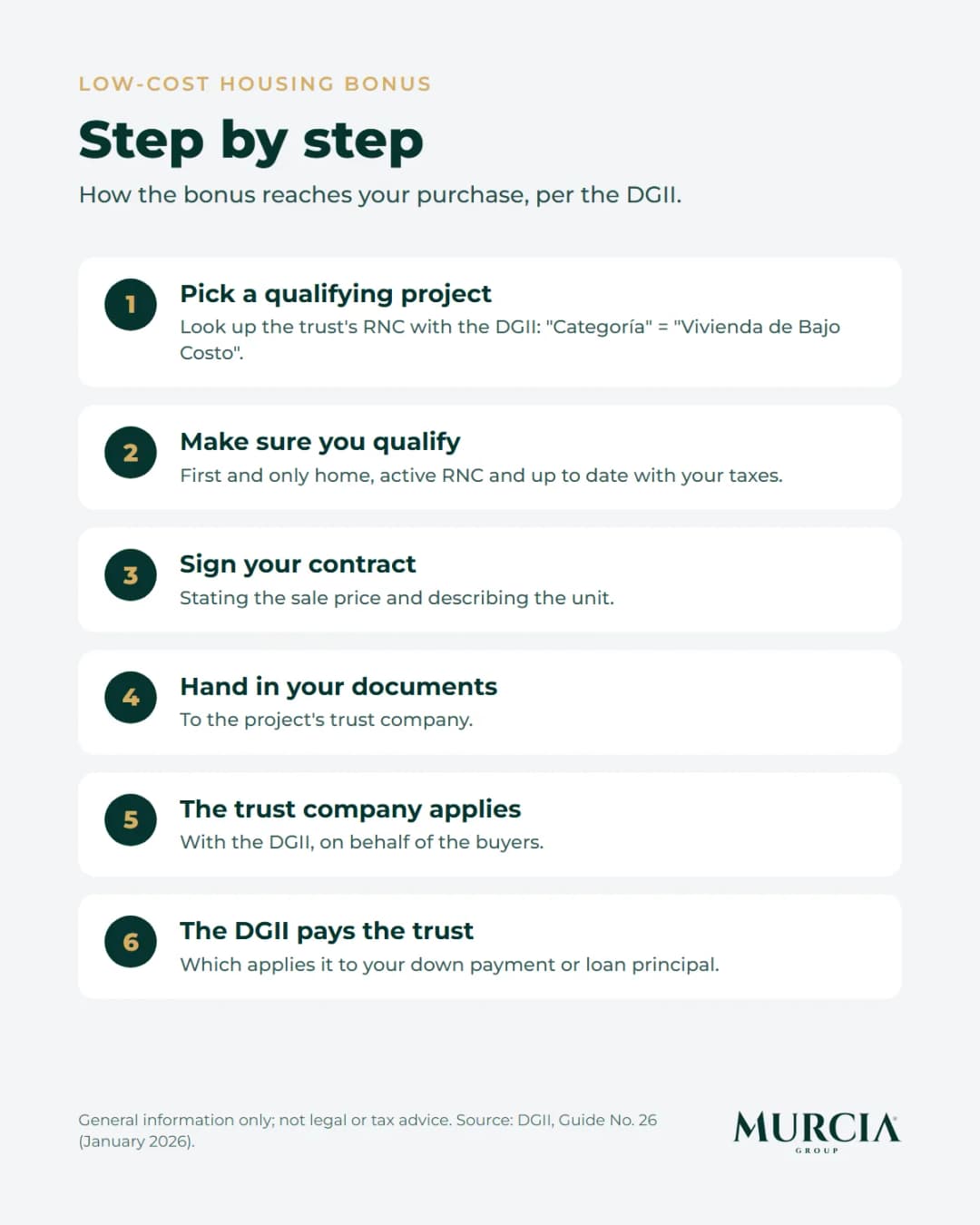
- Pick a qualifying project. Check in the DGII's RNC lookup that the project's trust is listed as "Vivienda de Bajo Costo" (see how below).
- Make sure you qualify: first and only home, active RNC and no outstanding tax debts.
- Sign your contract, which must state the sale price and describe the unit.
- Gather your documents and hand them to the project's trust company.
- The trust company files the request with the DGII on your behalf. You don't file it yourself.
- The DGII pays the bonus to the trust, which applies it to your purchase: to your down payment or your loan principal.
Required documents
The trust company submits the following, according to the DGII's Housing Bonus page and General Rule 01-2015:
- Form FI-GERE-001, filled out, signed and stamped by the trust company.
- A certificate from the National Cadastre Office (Catastro Nacional) showing that neither you nor your spouse own registered property.
- A copy of the contract with the price and unit description: a three-party contract (bank, trust and buyers) or a final purchase agreement for finished units, or a promise-to-sell agreement for units at least 80% complete.
- ID cards (cédulas, both sides) for you and your spouse, or passports for Dominicans living abroad.
- A birth certificate, if any buyer is a minor.
- A sworn statement of residence, apostilled or notarized at a Dominican consulate, if you live abroad.
- A certificate from the trust company confirming the unit is at least 80% complete, when a promise-to-sell agreement is used.
Keep in mind: the contract can't be more than one year old when the request is filed.
The trust company files everything at the in-person service center at DGII headquarters or at the information desk of the nearest local DGII office.
How to check whether a project qualifies
You can check it yourself on the DGII website:
- Go to dgii.gov.do and open Herramientas › Consultas › RNC Contribuyentes.
- Search by the RNC of the project's trust or by its name.
- Look at the "Categoría" field: it should read "Vivienda de Bajo Costo".
To confirm that the project is registered with the DGII, you can contact its Trusts Department.
Frequently asked questions
Does the DGII pay me in cash?
No. The DGII pays the bonus to the project's trust, which applies it to your purchase: your down payment or your loan principal.
Can I apply for the bonus myself?
No. The project's trust company applies on behalf of the buyers. Your part is to give them complete documents on time.
How much will I get?
The DGII doesn't publish a fixed amount: the bonus is a refund of the ITBIS paid to build the project. Ask your trust company what applies to your unit.
Can I buy from abroad?
Yes, if you meet the requirements. Besides your passport, you'll need a sworn statement of residence, apostilled or notarized at the consulate, and a first-degree relative must live in the home.
Can I rent the home out later?
According to Guide No. 26, not during the first 5 years. If you rent it out or transfer it earlier, you'd have to pay back the full bonus or a proportional share.
Ready for the next step?
If you're looking to buy your first home and want to know your options, a Murcia Group advisor can guide you, no strings attached. Reach us through our contact form or the WhatsApp button on this page.
Sources
- DGII, Bono Vivienda (accessed November 2, 2026; in Spanish).
- DGII, Taxpayer Guide No. 26: Low-Cost Housing Bonus (January 2026; in Spanish).
- DGII, Resolution DDG-AR1-2026-00001, section twelve (January 15, 2026; in Spanish).
Updated: November 2026.
General information only; this is not legal or tax advice. Confirm the requirements and the current price cap with the DGII or your trust company.